

Checking if a number is prime is pretty common in programming. A prime number’s only divisible by 1 and itself. Like, take the number 17; it’s prime since it has no divisors other than 1 and 17.
In this article, we’re gonna write a C program to check if an entered number is prime. So, let’s dive in!
Prerequisites for the C Program to Check Prime Number
Before you dive into the code, make sure you're familiar with these prerequisites.
- Basic understanding of conditional statements and loops in C
- Using the modulo
%operator to find remainders - Any C compiler such as GCC 9 or newer — or just run it in the EduSeekho online compiler
Source Code of C Program to Check Whether a Number is Prime or Not
Here's the complete C code to check if a number is prime.
#include <stdio.h>

int main() {
    int n, i, isPrime = 1;
    // Read number from user
    printf("Enter a number: ");
    scanf("%d", &n);

    // Check if n is less than or equal to 1
    if (n <= 1) {
        isPrime = 0;
    } else {
        // Check for factors from 2 to n/2
        for (i = 2; i <= n / 2; i++) {
            // If n is divisible by any i
            if (n % i == 0) {
                isPrime = 0;
                break;
            }
        }
    }

    // Output the result
    if (isPrime) {
        printf("%d is a prime number.\n", n);
    } else {
        printf("%d is not a prime number.\n", n);
    }

    return 0;
}
Try this code yourself — free
Run it in the EduSeekho online compiler. No setup needed.
Output of the Check Whether a Number is Prime Program
Let's see the result when you run this program.
Enter a number: 17
17 is a prime number.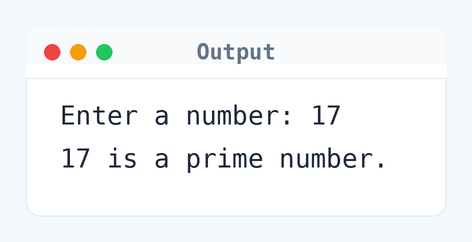
Algorithm to Check Whether a Number is Prime in C
Checking if a number is prime involves testing its divisibility. Here's how this program accomplishes the task, step by step.
- Read the integer
nfrom the user. - Initialize
isPrimeto 1, assuming the number is prime. - If
nis less than or equal to 1, setisPrimeto 0. - For each
ifrom 2 ton/2: - If
nis divisible byi, setisPrimeto 0 and break the loop. - Output the result based on the value of
isPrime.
flowchart TD
  A([Start]) --> B[/Input n/]
  B --> C[isPrime = 1]
  C --> D[/If n <= 1/]
  D -->|Yes| E[isPrime = 0]
  E --> I["Output isPrime"]
  D -->|No| F["for (i = 2; i <= n/2; i++)"]
  F --> G{"n %% i == 0?"}
  G -->|Yes| H[isPrime = 0]
  H --> I
  G -->|No| F
I --> J([End])How the C Program to Check Prime Number Works
Here’s a detailed breakdown of how the code works, line by line.
#include <stdio.h>: Includes the standard input-output library, needed forprintfandscanf.int main(): The main function where the execution begins.int n, i, isPrime = 1;: Declares integer variablesnandi, and initializesisPrimeto 1, assumingnis prime until proven otherwise.scanf("%d", &n);: Reads an integer from the user and stores it inn.if (n <= 1): Checks ifnis less than or equal to 1; if so, it's not prime.- The
elseclause handles numbers greater than 1 to check for factors. for (i = 2; i <= n / 2; i++): Loops from 2 ton/2to check for factors.if (n % i == 0): Ifnis divisible byi, it's not prime, andisPrimeis set to 0.printf("%d is a prime number.\n", n);: IfisPrimeremains 1, output thatnis prime.printf("%d is not a prime number.\n", n);: Otherwise, output thatnis not prime.return 0;: Ends the main function, returning 0 to indicate successful execution.
Quick Quiz — test your understanding
Tap an option to check your answerWhich number will the loop start checking divisibility from?
How Fast Is the Check Prime Number Program in C?
Understanding the time and space complexity of this program helps optimize performance.
Time Complexity: O(n/2) where n is the entered number. The loop runs up to n/2 iterations, making it perform about 10 checks for n = 20.
Space Complexity: O(1). Only n, i, and isPrime are used — three ints, regardless of the input size.
Common mistake:Not initializing isPrime can give you the wrong results.
Key takeaway:Getting the hang of primality tests is key in number theory and algorithm tweaks.
FAQs About Checking if a Number is Prime in C
Here are answers to some common questions about this program.
Related Programs
If you found this program helpful, check out these related programs:
- C Program to Display Factors of a Number
- C Program to Check Prime or Armstrong Number Using User-defined Function
- C Program to Check if a Number is Sum of Two Primes
- C Program to Check Armstrong Number
- C Program to Display Armstrong Number Between Two Intervals
Conclusion
With this program, you can easily check if a number is prime. Next, give writing a program to find all prime numbers in a range a shot. It builds on this logic and helps with more advanced number theory problems.
Test your skills with our C quiz or try running the code again in the online compiler.