

You've been doing a lot of division in your C class, but what’s the remainder when you divide 20 by 3? This program will compute both the quotient and the remainder for you.
We're gonna use simple division in C. Let’s dive into this quick program.
Prerequisites for the C Program to Compute Quotient and Remainder
Here's what you need to know and have:
- Variable declaration using int type.
- The division "/" and remainder "%" operators.
<stdio.h>for input and output functions.- Any C compiler such as GCC 9 or newer — or just run it in the EduSeekho online compiler.
Source Code of C Program to Compute Quotient and Remainder
Let's see the source code for this program. We'll use standard input and output functions to achieve our goal.
#include <stdio.h>

int main() {
    int a, b, quotient, remainder;
    // Read two integers from the user
    printf("Enter the dividend: ");
    scanf("%d", &a);
    printf("Enter the divisor: ");
    scanf("%d", &b);

    // Calculate quotient and remainder
    quotient = a / b;
    remainder = a % b;

    // Print results
    printf("Quotient = %d\n", quotient);
    printf("Remainder = %d\n", remainder);

    return 0;
}
Try this code yourself — free
Run it in the EduSeekho online compiler. No setup needed.
Output of the Compute Quotient and Remainder Program
Here's what you'll see when you run this program:
Enter the dividend: 20
Enter the divisor: 3
Quotient = 6
Remainder = 2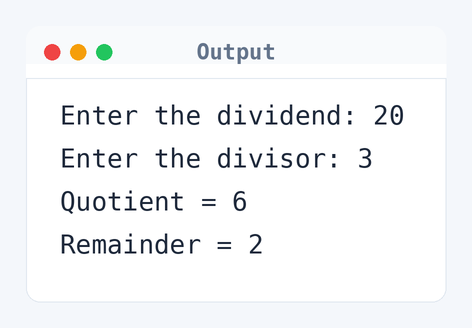
Algorithm to Compute Quotient and Remainder in C
Computing the quotient and remainder involves dividing one number by another. Here's how this program goes about it:
- Read the dividend and divisor from the user.
- Calculate the quotient by dividing the dividend by the divisor.
- Calculate the remainder using the modulus operator
%. - Output the calculated quotient and remainder.
flowchart TD
  A([Start]) --> B[/Read a and b/]
  B --> C[quotient = a / b]
  C --> D[remainder = a %% b]
  D --> E[/Print quotient and remainder/]
  E --> F([End])
How the C Program to Compute Quotient and Remainder Works
This program takes two integers from the user and performs arithmetic to find the quotient and remainder. Let's break it down:
- The program starts by including the header file
<stdio.h>to allow input and output operations. - Inside the
main()function, declare four int variables:a,b,quotient, andremainder. - Use
printfandscanfto read the dividend and divisor from the user. - The division
a / bcomputes the quotient and stores it in the variablequotient. - The modulus operation
a % bcomputes the remainder and stores it in the variableremainder. - Finally,
printfcommands output the calculatedquotientandremainderto the user. - The program ends by returning
0frommain(), indicating successful execution.
Quick Quiz — test your understanding
Tap an option to check your answerWhat does the remainder operator (%) do in C?
Time and Space Complexity of the C Program to Compute Quotient and Remainder
Let's consider how efficient this program is in terms of time and space.
Time Complexity: The time complexity is O(1) because the operations a / b and a % b each take a constant amount of time, regardless of the input size. The same set of operations is performed every time you run the program.
Space Complexity: The space complexity is also O(1) because we only store a small fixed number of variables: a, b, quotient, and remainder. This does not grow with input size.
Common mistake: Dividing by zero isn’t defined in C, and it'll lead to a runtime error. Just make sure your divisor isn’t zero.
Key takeaway: The % operator shows what’s left after dividing one number by another.
FAQs About Computing Quotient and Remainder in C
Here are some common questions students ask about this program.
Related Programs
If you found this program helpful, check out these related programs:
- C Program to Add Two Integers with Explanation and Output
- C Program to Multiply Two Floating-Point Numbers
- C Program to Count Number of Digits in an Integer
- C Program to Reverse a Number with Example
- C Program to Check Whether a Number is Palindrome or Not
Conclusion
If you’re scheduling tasks or splitting resources, knowing how to compute quotients and remainders really helps. Try modifying this code for more inputs or even float values. It’s great practice with arithmetic in C.
Practice more C programming with our quiz and test out the code yourself in the EduSeekho online compiler.