

Calculating standard deviation is common in stats. It helps figure out how your data's spread out. If you've got numbers like 2, 4, 4, 4, and 5, you’ll wanna know how much they deviate from the average. This C program takes a list and calculates their standard deviation.
Standard deviation might seem tricky, but it’s super useful. Let’s dive into coding it in C, and you'll get the hang of its application.
Prerequisites for the C Standard Deviation Program
Before diving into the code, ensure you have the following:
- Understanding of arrays in C.
- Familiarity with loops and arithmetic operations.
- Any C compiler such as GCC 9 or newer — or just run it in the EduSeekho online compiler.
Source Code of C Program to Calculate Standard Deviation
Here's the complete C program to calculate the standard deviation for a set of numbers. Follow along with the comments to understand each part.
#include <stdio.h>
#include <math.h>

int main() {
    int n, i;
    float sum = 0, sumSq = 0, mean, variance, std_deviation;
    int element[100];

    // Read number of elements
    printf("Enter the number of elements: ");
    scanf("%d", &n);

    // Read elements
    printf("Enter %d elements: ", n);
    for (i = 0; i < n; i++) {
        scanf("%d", &element[i]);
        sum += element[i];
        sumSq += element[i] * element[i];
    }

    // Calculate mean and variance
    mean = sum / n;
    variance = (sumSq / n) - mean * mean;

    // Calculate standard deviation
    std_deviation = sqrt(variance);

    printf("Standard Deviation = %.3f", std_deviation);

    return 0;
}
Try this code yourself — free
Run it in the EduSeekho online compiler. No setup needed.
Output of the Standard Deviation Program
Here's what you can expect when you run the program.
Enter the number of elements: 5
Enter 5 elements: 2 4 4 4 5
Standard Deviation = 1.095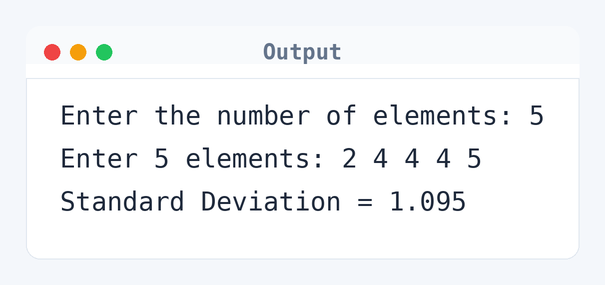
Algorithm to Calculate Standard Deviation in C
Standard deviation tells how much data deviates from the average. This program reads numbers, computes their mean, and calculates the variance, then derives the standard deviation.
- Read the integer
nfrom the user. - Initialize
sumandsumSqto zero. - For each element, accumulate the sum and sum of squares.
- Calculate the mean by dividing
sumbyn. - Compute variance using the accumulated sums.
- Calculate standard deviation as the square root of variance.
flowchart TD
  A([Start]) --> B[/Read n/]
  B --> C[sum = 0, sumSq = 0]
  C --> D{for each element}
  D -->|Yes| E[sum += element[i]]
  E --> F[sumSq += element[i] * element[i]]
  F --> D
  D -->|No| G[mean = sum / n]
  G --> H[variance = (sumSq / n) - mean * mean]
  H --> I[std_deviation = sqrt(variance)]
I --> J([End])How the C Program to Calculate Standard Deviation Works
Let's break down how this program calculates standard deviation step by step:
#include <stdio.h>and#include <math.h>bring in necessary functions for input/output and math operations.- The program starts by declaring variables like
n,sum,sumSq,mean, and storage for elements. - It reads the number of elements
nand then proceeds to read each element into the arrayelement. - The loop sums up the elements and their squares, updating
sumandsumSq. - Mean is calculated by dividing
sumbyn, giving the average of numbers. - The variance is then calculated using
(sumSq / n) - mean * mean. - Finally,
sqrtcomputes the standard deviation from the variance, which is printed out.
Quick Quiz — test your understanding
Tap an option to check your answerWhat does the standard deviation measure?
Time and Space Complexity of the C Standard Deviation Program
Considering performance, here's how the program fares:
Time Complexity: O(n). n is the number of elements entered by the user—e.g., 5 for five numbers. We loop over all numbers once to calculate the sum and sum of squares. Each additional element requires one more loop cycle.
Space Complexity: O(n). We store the array element of size n, but also use a few additional variables like sum, sumSq, and mean. These variables do not grow with the input size.
Common mistake:Not including #include <math.h> can cause undefined behavior when using sqrt.
Key takeaway:Standard deviation shows how spread out the values in a data set are, and it’s a great tool in data analysis.
FAQs About Calculating Standard Deviation in C
Here are some common questions students have about this program.
<math.h> library's needed for functions like sqrt to calculate square roots.element array size if needed.sum for the mean and sumSq for the variance, which involves squaring each number.element to float and tweak the scanf format specifier accordingly.Related Programs
If you found this program helpful, check out these related programs:
- C Program to Calculate Simple and Compound Interest
- C Program to Calculate Difference Between Two Time Periods
- C Program to Check Leap Year with Code and Output
- C Program to Find the Area and Perimeter of a Rectangle
- C Program to Calculate Area and Circumference of Circle
Conclusion
Standard deviation’s an important concept in statistics and data analysis. This C program shows you how it's calculated and why it matters. Try playing around with different data sets to get a better feel for its uses.
Test your knowledge with our C programming quiz and run similar programs in our online compiler.